Drive a current through a crystal and measure the voltage along it to see how its resistance changes with temperature. Move the probes to opposite sides to study the Hall response. By varying field, temperature or illumination, we use these signals to follow what electrons do in quantum materials.
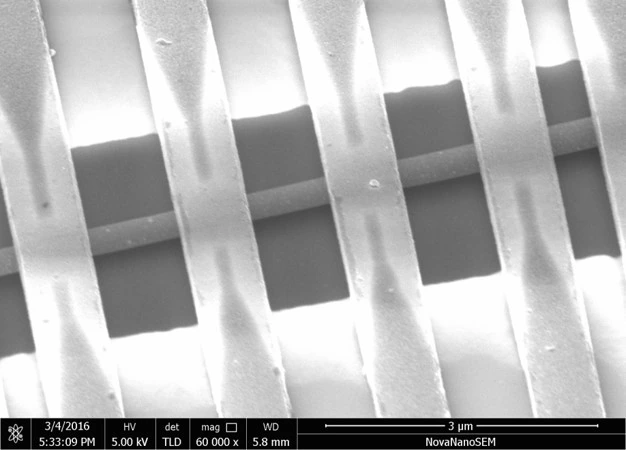
Device micrograph from the lab archive. Scale bar: 3 µm.
What is mesoscopic physics?
A micrograph tells you how large a device is. To decide whether electrons can show measurable interference, you need another length: how far can they travel while retaining phase information? That distance can change with temperature.
What happens to a voltage driven by heat when a magnetic field confines electrons to their lowest Landau level? We study crystals of ZrTe₅, where a temperature difference along the sample produces voltages both along and across it.
Combining the thermoelectric response with electrical resistivity measurements gives the transverse thermoelectric conductivity, αₓᵧ. At fixed temperature deep in the quantum limit, αₓᵧ stayed nearly constant as the field increased.
How wide a range of wavelengths can one detector sense? We stack MoTe₂, graphene and SnS₂ into a junction and measure how its current changes when light is switched on and off.
At room temperature, the device responded at test wavelengths from 405 to 1550 nm. Its response at 1550 nm took seconds, considerably longer than at the shorter wavelengths tested.
How does thinning a crystal change the temperature at which superconductivity sets in? We compare resistance as a function of temperature in MoTe₂ flakes of different thicknesses. Cooling through a superconducting transition produces a sharp drop in resistance.
In a 4 nm flake, the resistance had fallen to 90% of its value at 10 K by 5.3 K. The paper reports 5.3 K as the onset temperature using this criterion. The measurement ended before a complete drop to zero resistance could be established.
Few-layer ZrTe₅ can degrade during processing. In a collaborative study, researchers transferred thin flakes onto metal contacts embedded in hexagonal boron nitride. This let them connect a fragile crystal to a measurement circuit while limiting damage during fabrication.
The researchers measured voltages along and across the current while varying the magnetic field. Comparing the two traces revealed minima in longitudinal conductivity and emerging plateaus in Hall conductivity, signatures of the integer quantum Hall effect in the thin flakes.